RailroadTrain Museum Day
2026-08-09
One visit, one brass plate, and a thread that kept going. This note collects every photo from the day, the labeled diagrams we built from them, and three interactive animations of the patents we dug out of a Westinghouse builder's plate. It reads top to bottom in the order the day unfolded. Photos, diagrams and animations are attachments in files/, embedded by name.
[!note] The animations are live
Section 10's three interactive 3D exhibits are in files/ and embedded below. On the web they render in a sandboxed frame; in Obsidian they need the community plugin HTML Embed (by The Pieza).
1 · The payroll that started it
A Central Pacific payroll sheet from March 1865, the very month the railroad went all-in on Chinese labor for the Sierra crossing. The workers almost never appear by name. Each gang is listed under its headman — Ah Fong, Sam Sing, Hung Wah — with days worked tallied collectively at roughly a dollar a day, wages often routed through merchant brokers rather than paid directly. Sheets like this one are nearly all that survives of some ten thousand lives.
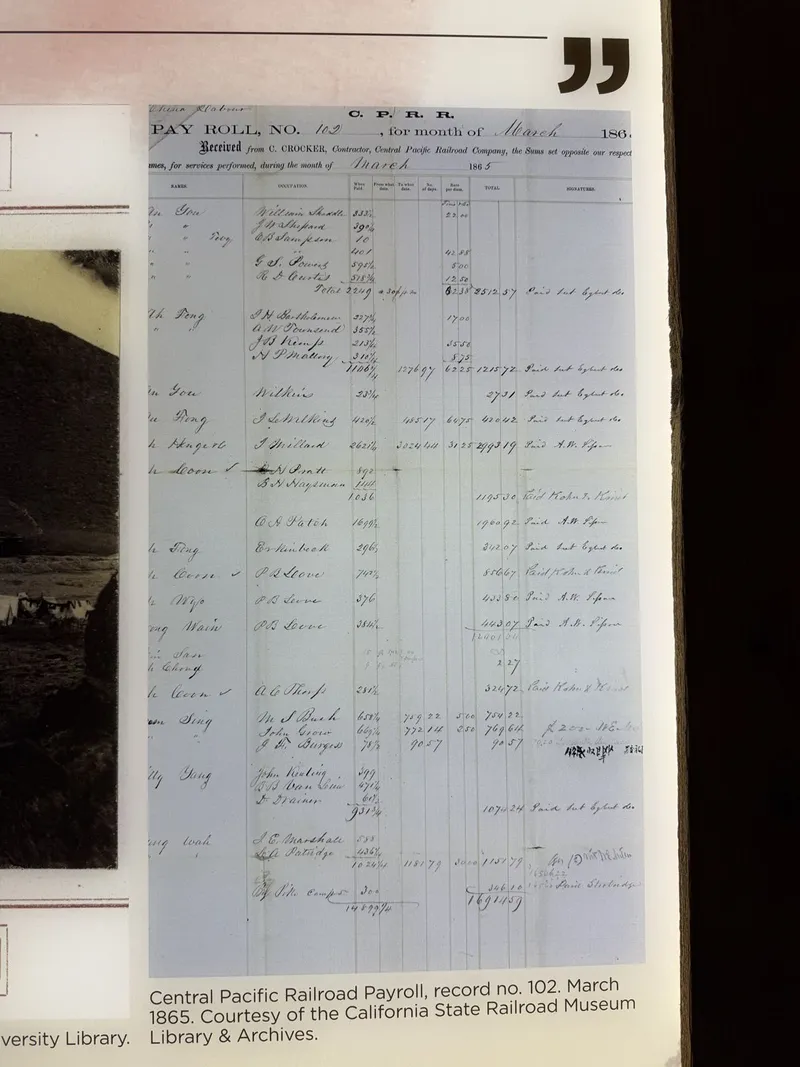
The payroll itself, penciled "China Labour" at the top corner: Pay Roll No. 102, C.P.R.R., received from C. Crocker, Contractor. Gang names down the left in a clerk's looping hand, day counts and totals in ruled columns, and — rare beyond price — a set of Chinese characters near the Sam Sing entry where a worker signed for himself.
2 · The Gov. Stanford and its builder's plate
The museum's centerpiece diorama holds Central Pacific's Locomotive No. 1, the Gov. Stanford — built in Philadelphia in 1862 and shipped around Cape Horn because no railroad yet existed to carry it west.
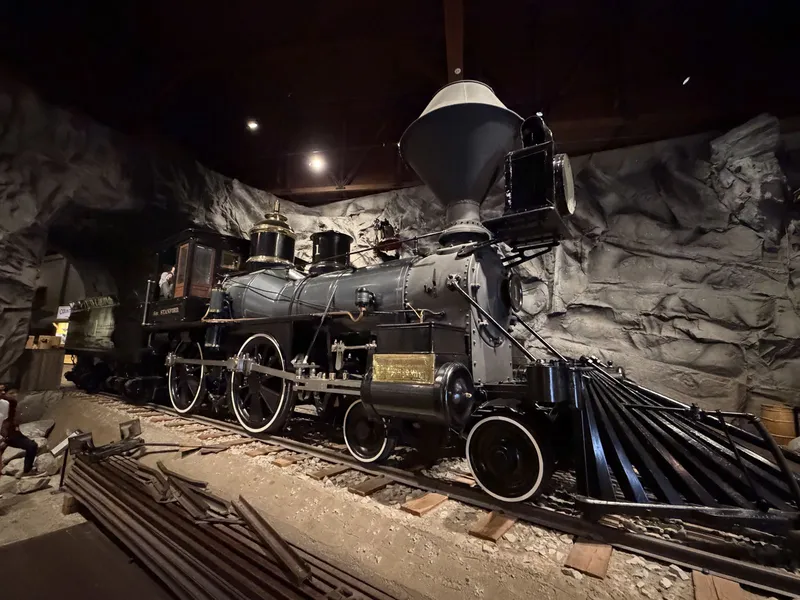
The whole engine in its rock-walled diorama: black boiler, balloon stack, giant oil headlamp, cowcatcher raking forward, gold "Gov. Stanford" lettering on the cab, and a mannequin engineer leaning from the window. A 4-4-0 American type, the classic silhouette of the era.
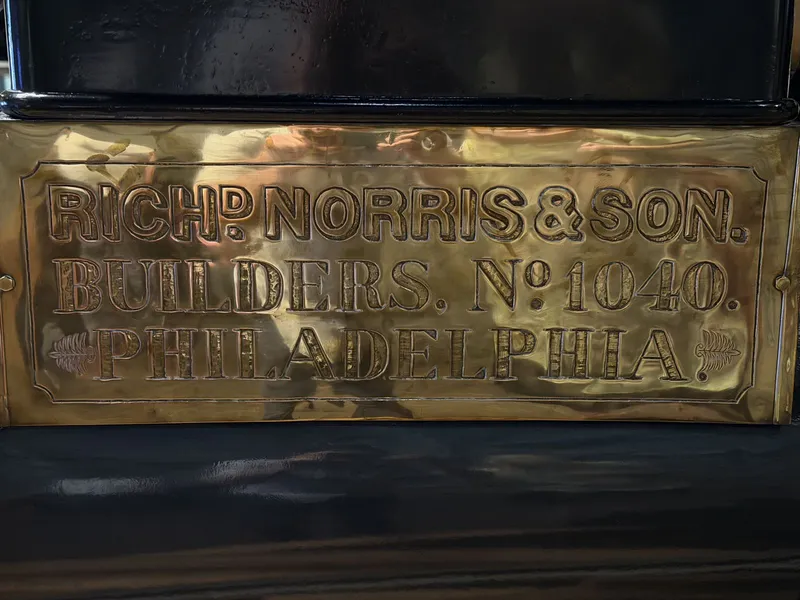
The brass builder's plate up close: "Rich'd Norris & Son, Builders, No. 1040, Philadelphia," flanked by little engraved ferns. Construction number 1040 is the serial that lets historians trace this engine through the Norris order books.
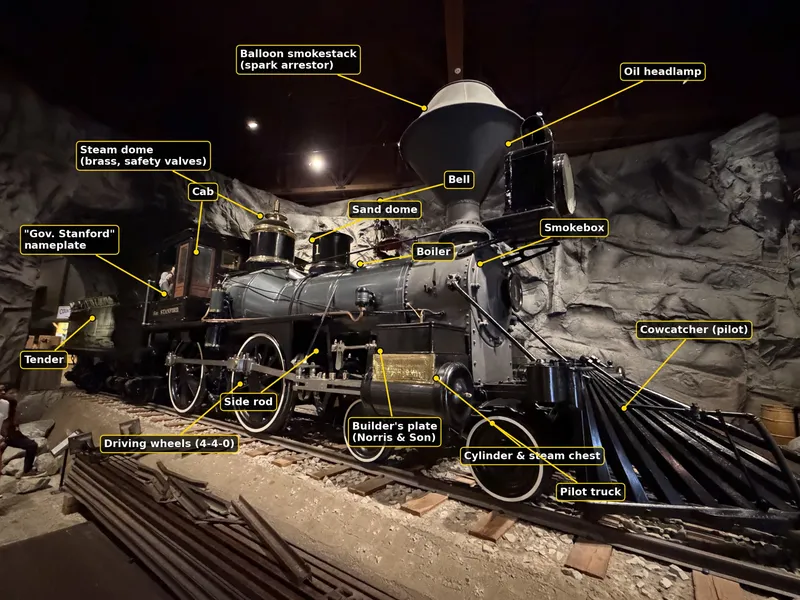
Our labeled diagram of the exterior — stack, domes, bell, boiler, rods, drivers, cowcatcher — every pointer checked against the photo.
3 · Inside the cab
The engineer's office. The backhead — the rear face of the boiler — carries every control the crew lived by.
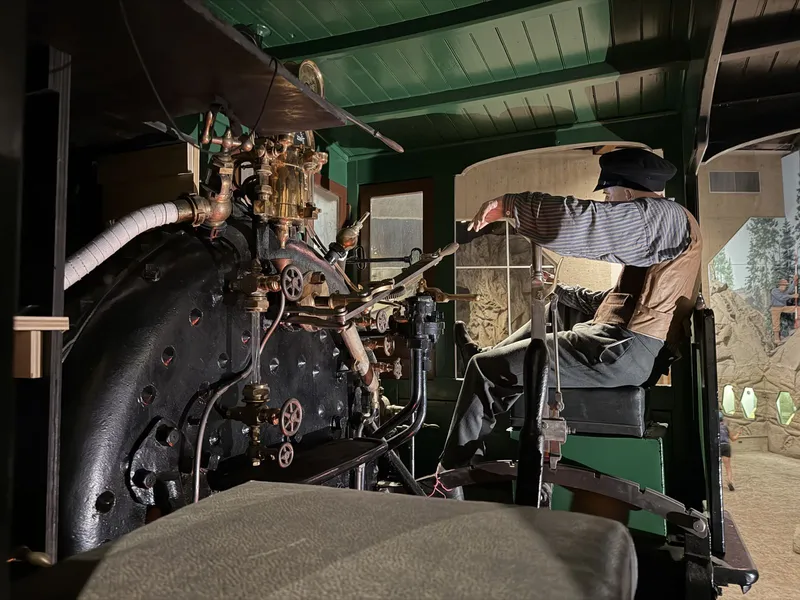
Inside the Gov. Stanford's cab: green-painted woodwork, the black riveted backhead crowded with brass — pressure gauge on its curved pipe, tall ornate lubricator, wheeled valves — the long Johnson bar with its notched quadrant, and a mannequin engineer at his armrest watching the road.
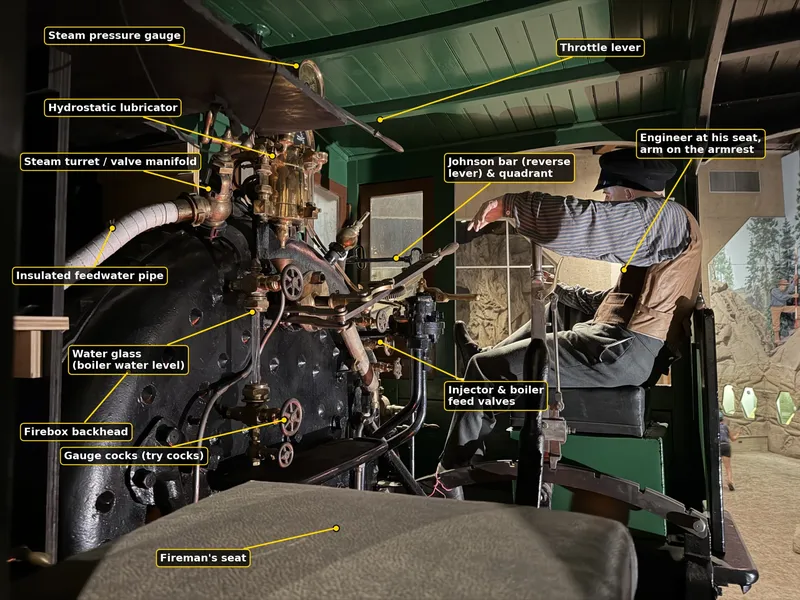
The same photo with every control named: steam gauge, water glass, gauge cocks, throttle, reverse lever, injector valves, and the seats for both crewmen.
4 · The Scribner's key, recovered
A museum panel reproduced an 1888 Scribner's Magazine engraving of a cab with more than fifty numbered controls — but cropped off the key. The engraving comes from M. N. Forney's writing, and the full numbered list survives in The American Railway (1889). We paired the engraving with all 52 original identifications, so the numbers mean something again.
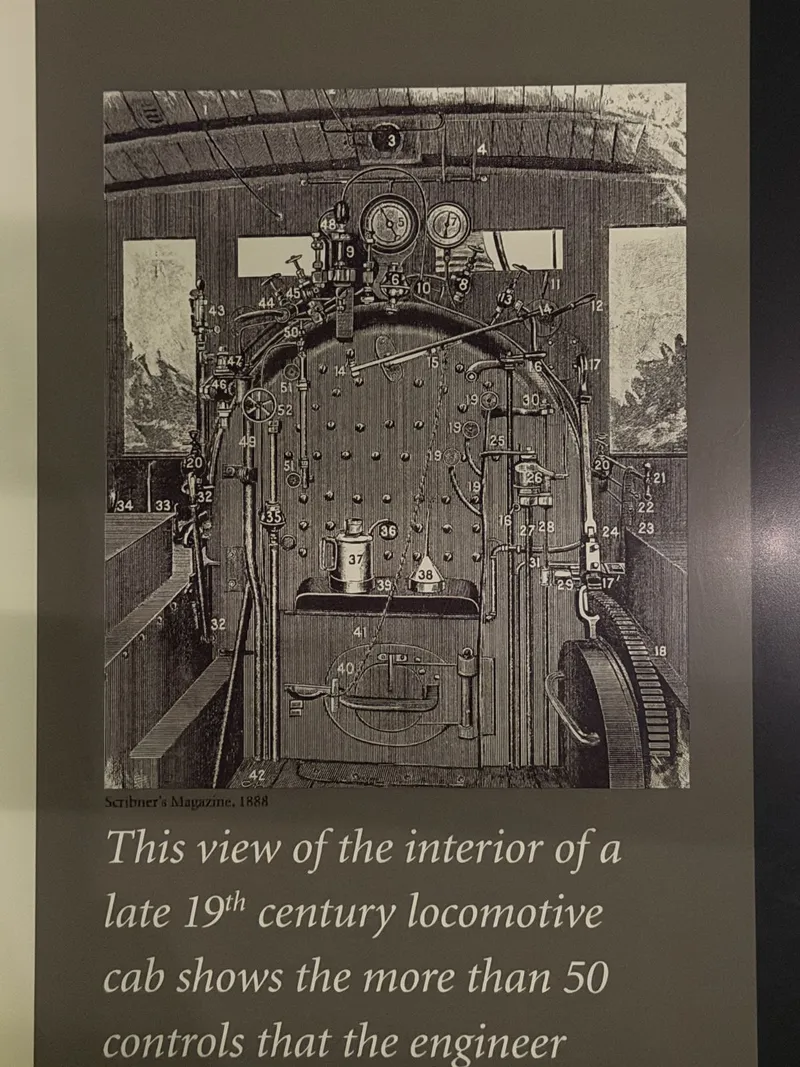
The panel as displayed: a sepia engraving of a New York Central locomotive cab, numbers 1 through 52 scattered across gauges, cocks, levers, and the fireman's tallow cans — with the caption "Scribner's Magazine, 1888" and no key in sight.
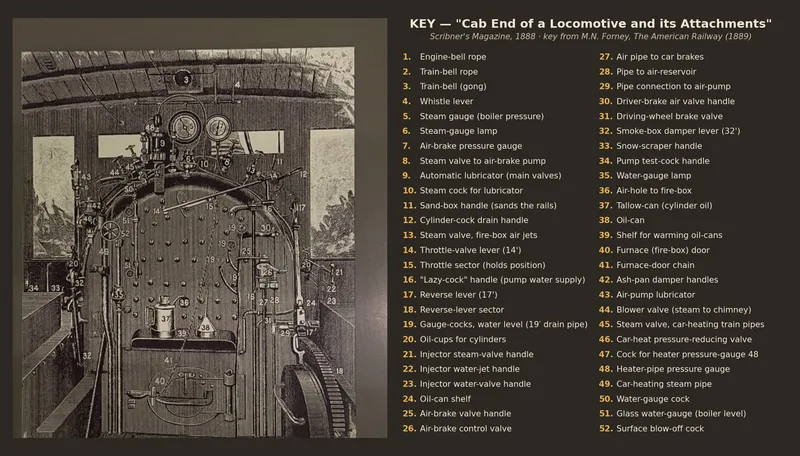
The recovery: the engraving beside the complete 52-item key from Forney's 1889 book, every number identified in the original words.
5 · No. 12, and why old smokestacks were fat
A gorgeous 1876 Baldwin — likely the North Pacific Coast's Sonoma — with its balloon stack. The fat stack is a spark trap: wood fires throw embers, and the wide bonnet slows the exhaust so cinders drop out instead of setting the countryside alight. A fat stack is a reliable tell that an engine burned wood. (One close-up of the stack itself was lost to a filename collision when uploading — the side view survives.)
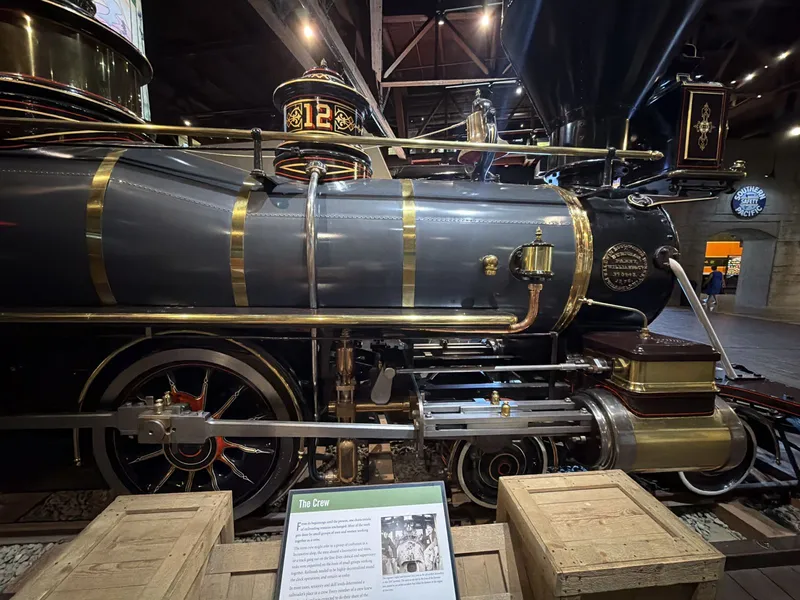
No. 12 in profile: slate-gray boiler with polished brass bands, the ornate sand dome painted with a gold "12," red-and-gold pinstriped wheels, brass-jacketed cylinder, and the Baldwin plate on her smokebox. Victorian machine-as-jewelry.
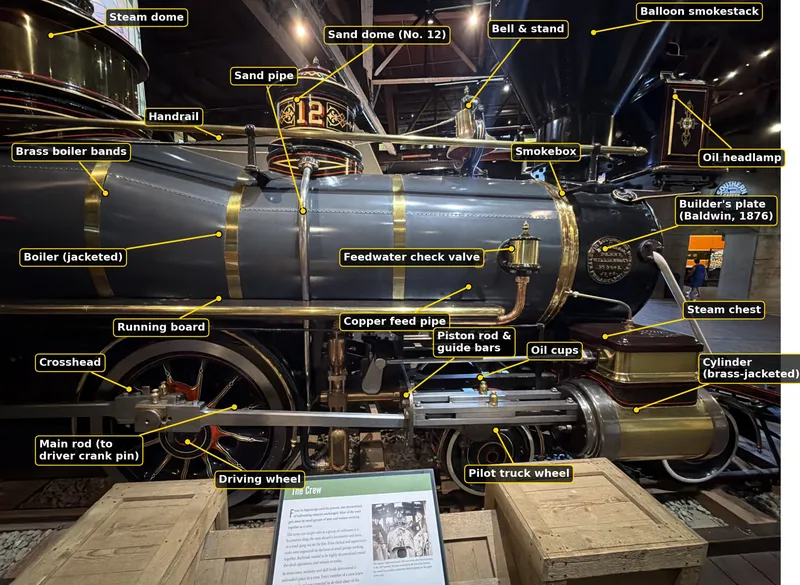
The labeled side view — every dome, pipe, rod, and wheel named, from the sand pipe down to the pilot truck.
6 · Weighing the giants
Two engines, two eras. Skookum, a 1909 Baldwin articulated logging Mallet: 162,650 pounds for the engine, 243,000 with tender — about 87 modern MINI Coopers. The Dayton, an 1873 4-4-0 from Central Pacific's own Sacramento shops: roughly 78,000 pounds, about 63 tons with tender. The per-part weights on the diagrams are honest estimates apportioned from period engineering breakdowns; the totals are documented.
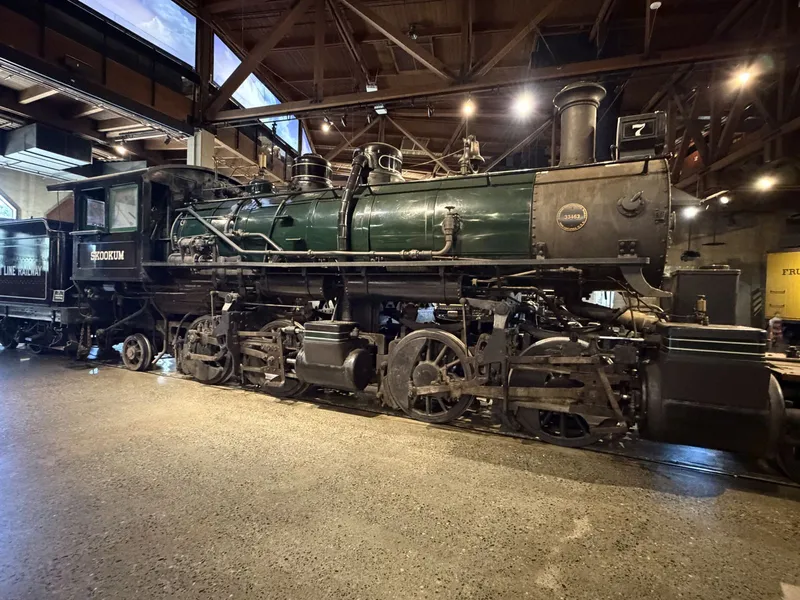
Skookum filling the shed: deep green boiler over two hinged sets of drivers, straight stack, the tender behind lettered for her logging railway. A compact giant built to drag timber around impossible curves.
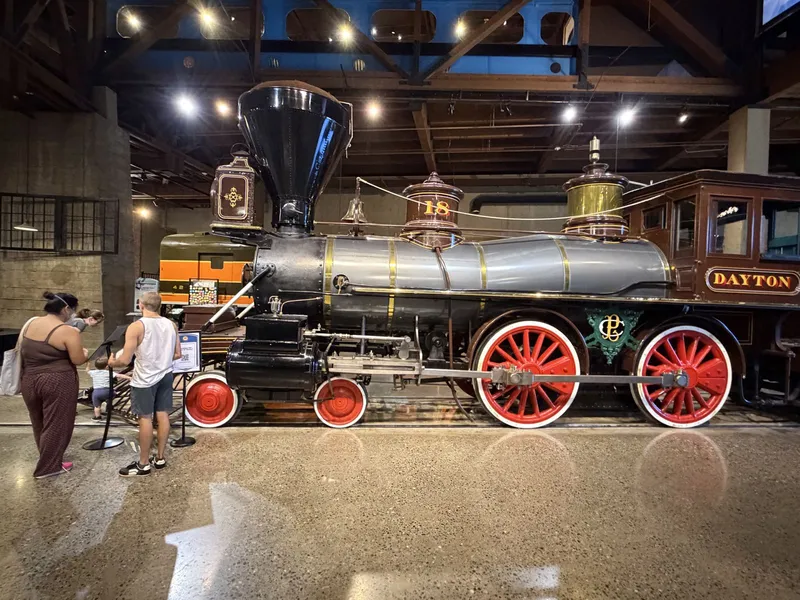
The Dayton, museum visitors at the rope for scale: silver boiler, bright red wheels, the green-and-gold CP monogram on her frame, "DAYTON" in gold on the cab panel. An engine built to be admired as much as worked.
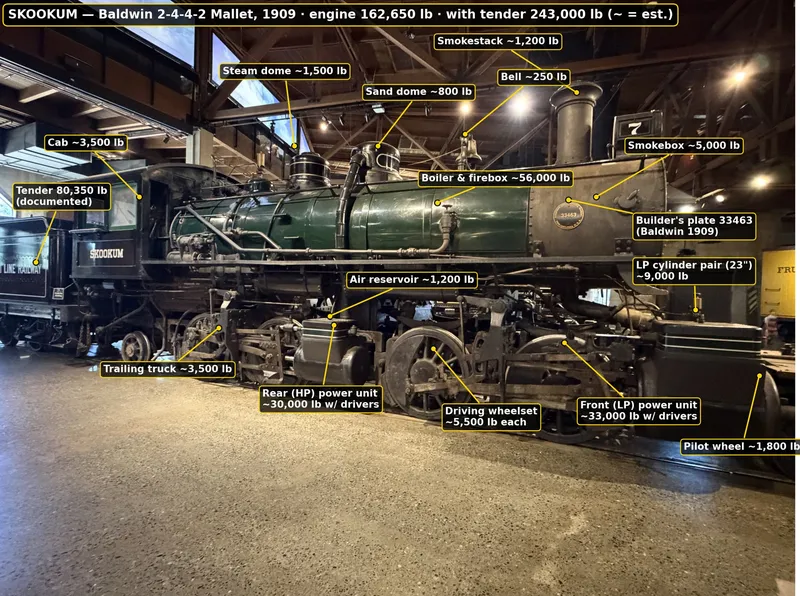
Skookum with weight tooltips — documented totals, estimated parts, the boiler alone around 56,000 pounds.
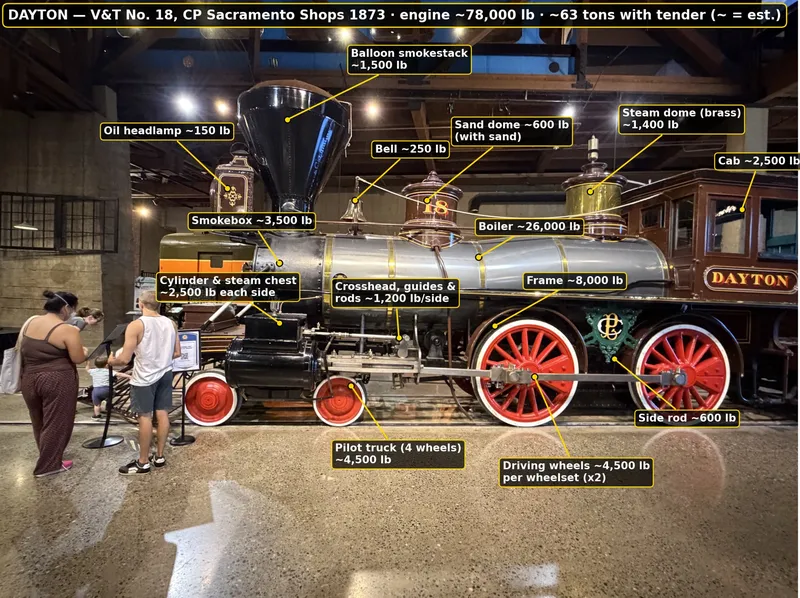
The Dayton's weight breakdown on the same system, tildes marking every estimate honestly.
7 · SP 4294, the last cab-forward
Southern Pacific's answer to suffocating in its own snowsheds: turn the locomotive around so the crew rides ahead of the exhaust. This is the only cab-forward left anywhere.
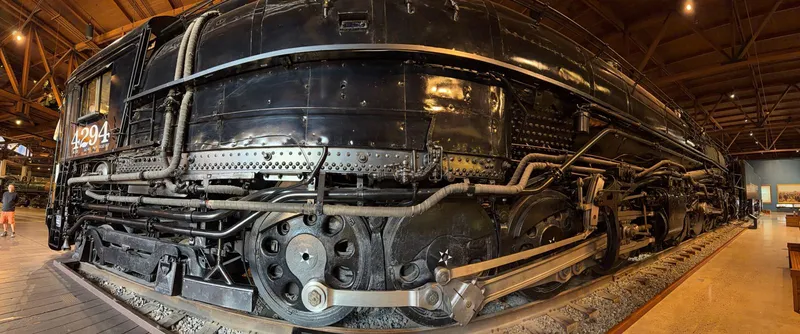
The panorama: 4294's number on the cab — at the front, which is the whole point — then a city block of black boiler, silver side rods, and disc drivers with little SP stars, curving away down the hall in the wide lens.
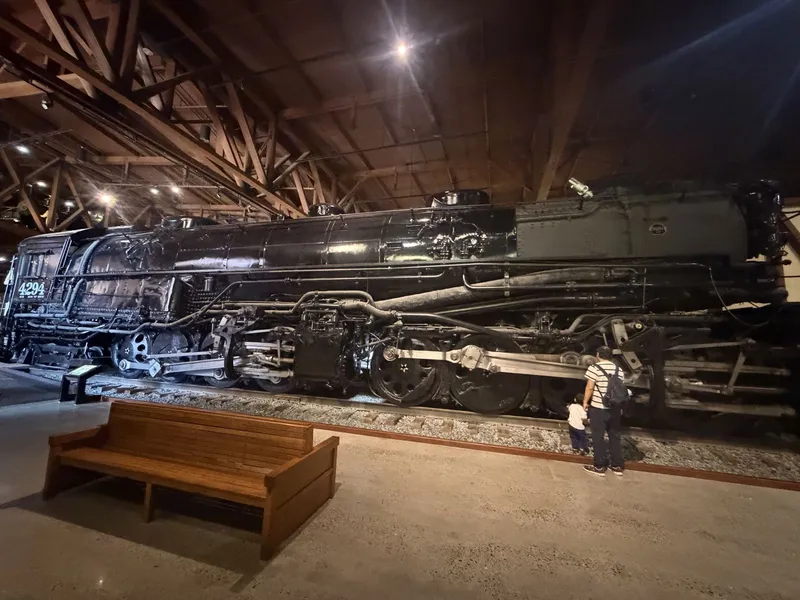
The full broadside from across the gallery, a wooden bench and a father and child at her wheels for scale. All 650,000-plus pounds of her at rest.
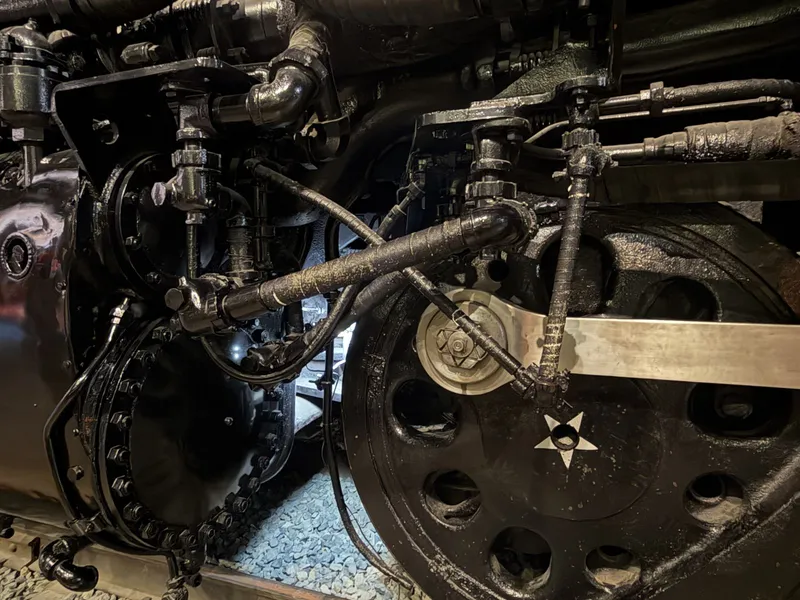
Close in on the running gear: the polished side rod meeting a crank pin with its big hex nut, a white star on the black disc driver, and the famous tangle of wrapped and armored lines — most of them, it turns out, carrying oil.
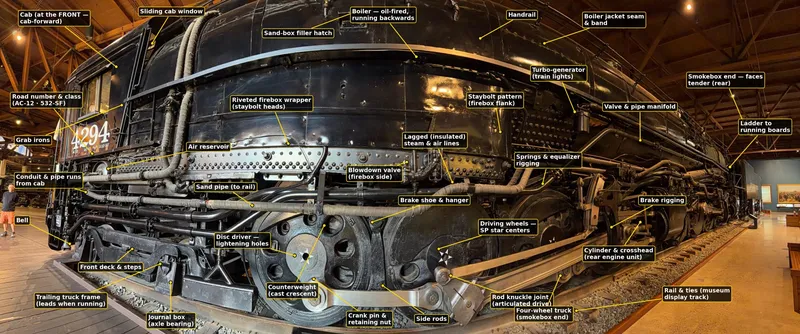
Thirty-five labels on the panorama, from the bell to the smokebox, staybolt bands to brake rigging.
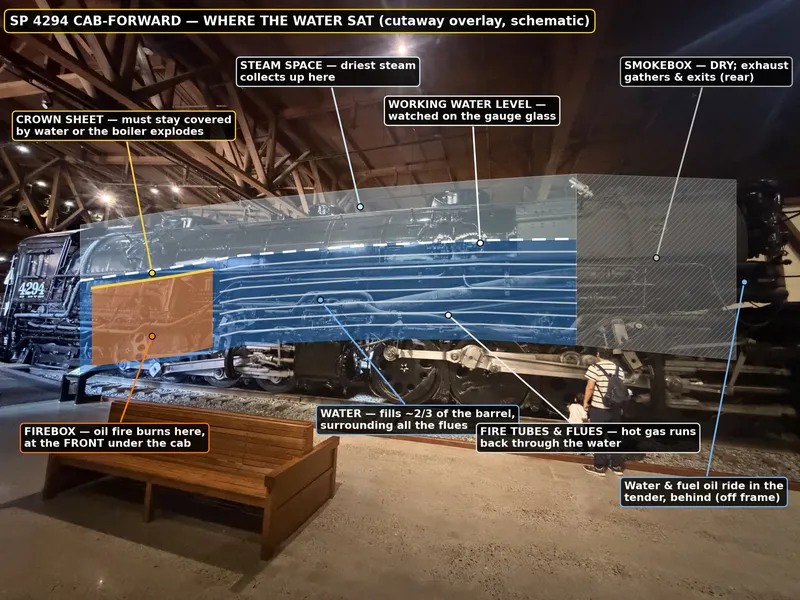
The cutaway overlay: blue for the water that filled two-thirds of the barrel, amber for the fire at the front, the dashed working water level, and the crown sheet that had to stay covered or the boiler exploded.
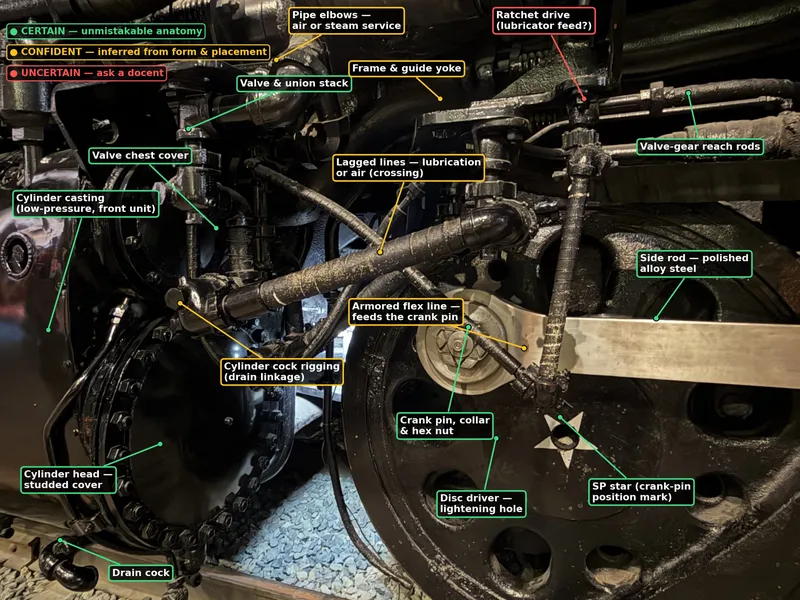
The pipe close-up labeled with honesty built in: green for dead-certain identifications, yellow for educated reads, red for the one genuine guess.
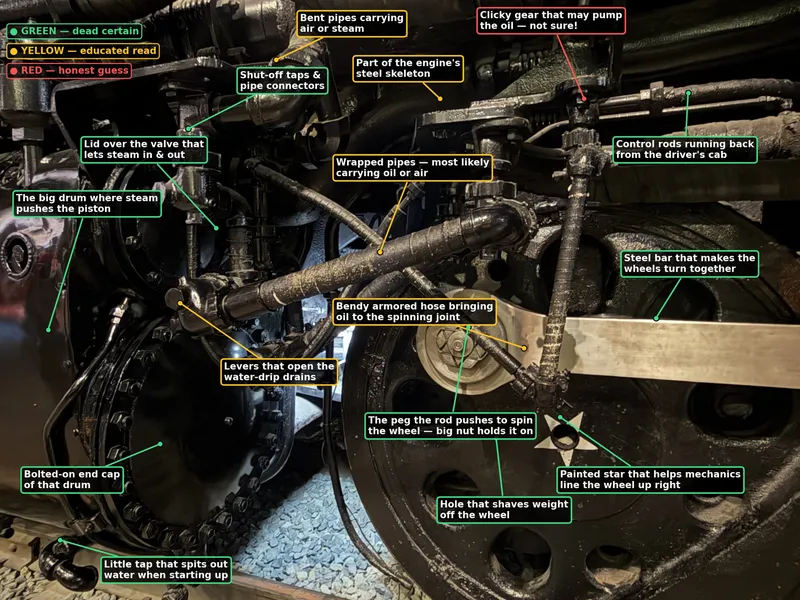
The same diagram translated into plain English — "the big drum where steam pushes the piston," "hole that shaves weight off the wheel."
8 · Around the rest of the museum
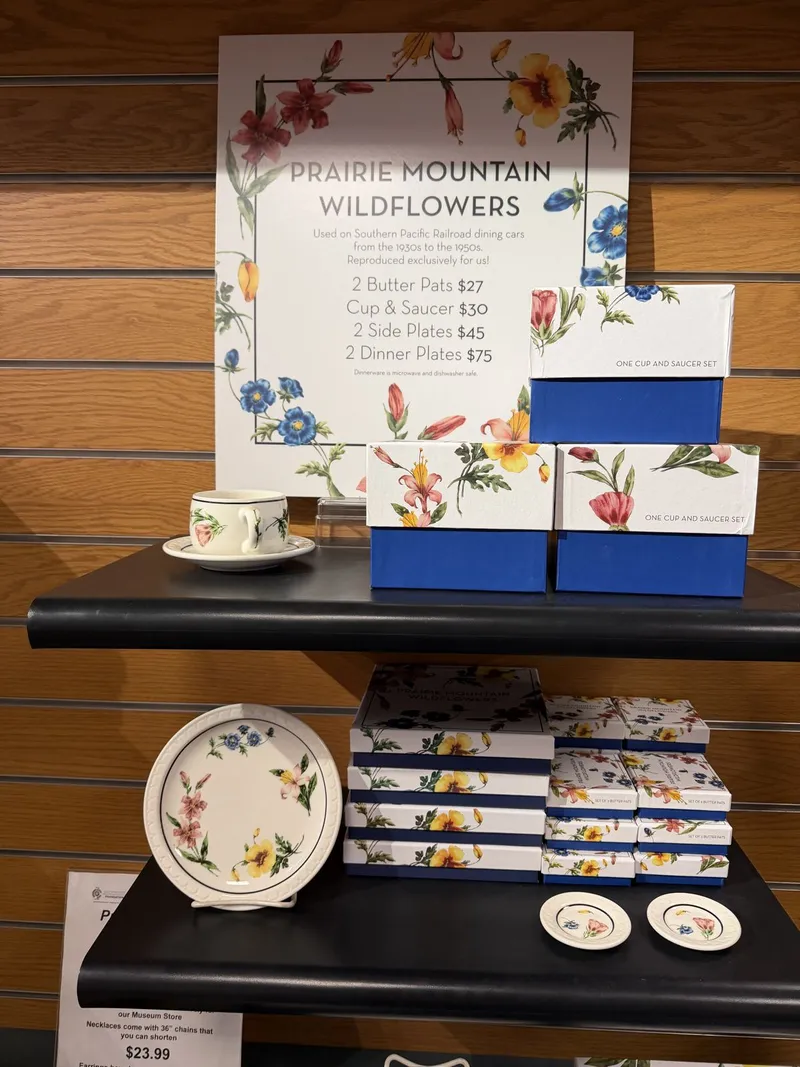
The gift shop's Prairie Mountain Wildflowers display: the reproduction china Southern Pacific ran in its dining cars from the 1930s to the 1950s — a cup and saucer on the shelf, floral-printed boxes stacked below, butter pats at $27 the pair.
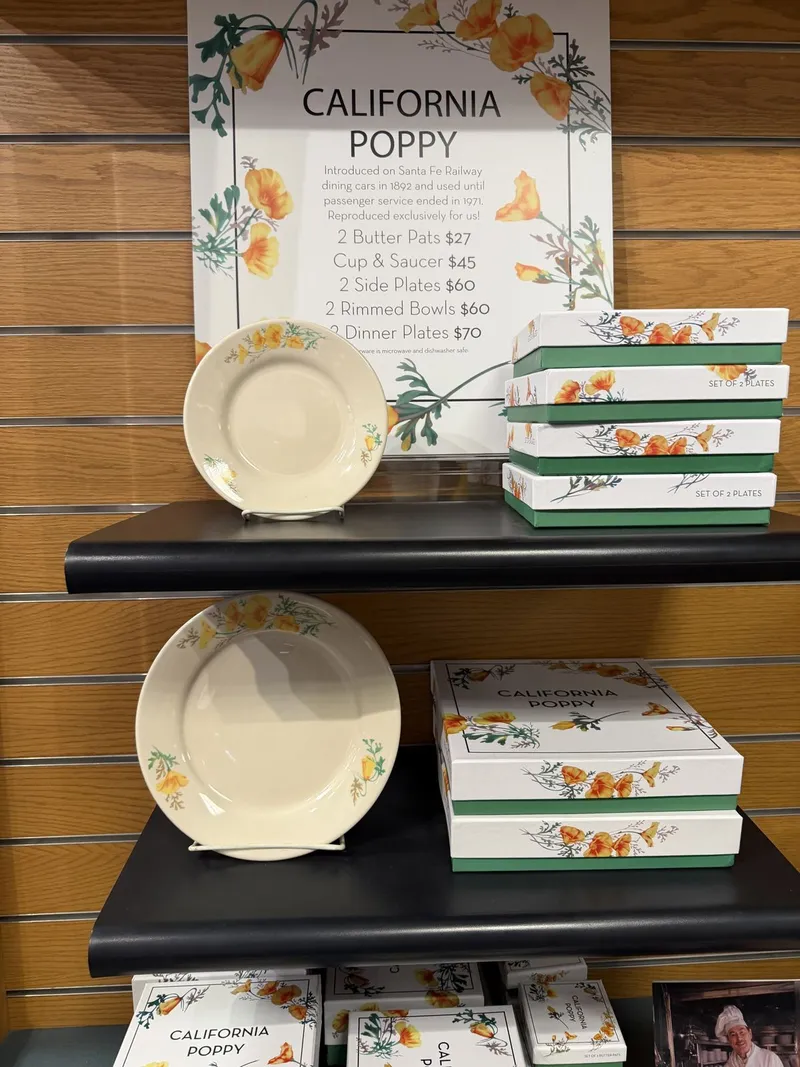
Its Santa Fe counterpart: California Poppy, the pattern introduced on dining cars in 1892 and served until passenger service ended in 1971 — cream plates with orange poppies, boxed sets in green and white.
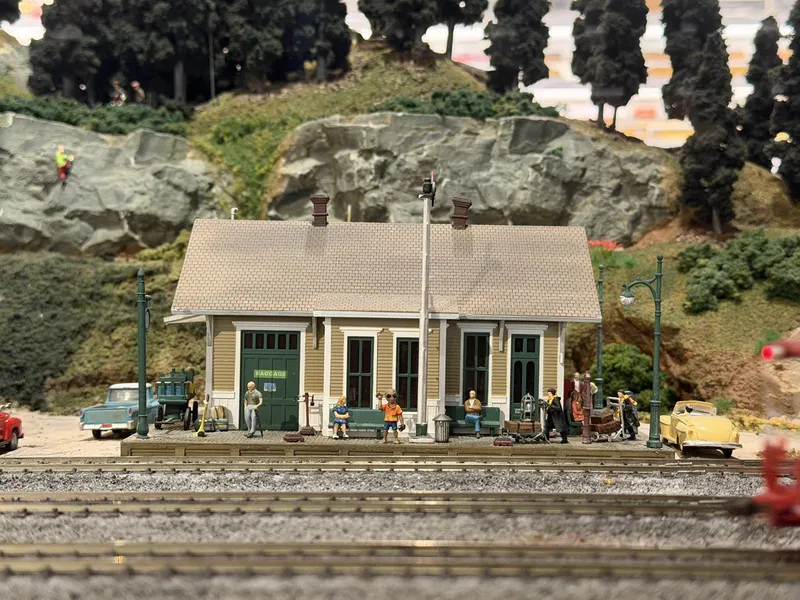
The model railroad's little depot: tan station with a green BAGGAGE door, figures waiting on the platform — including one gentleman in a loud Hawaiian shirt — a blue pickup and a yellow convertible parked outside, and if you look at the painted rocks above, a tiny climber halfway up the cliff.
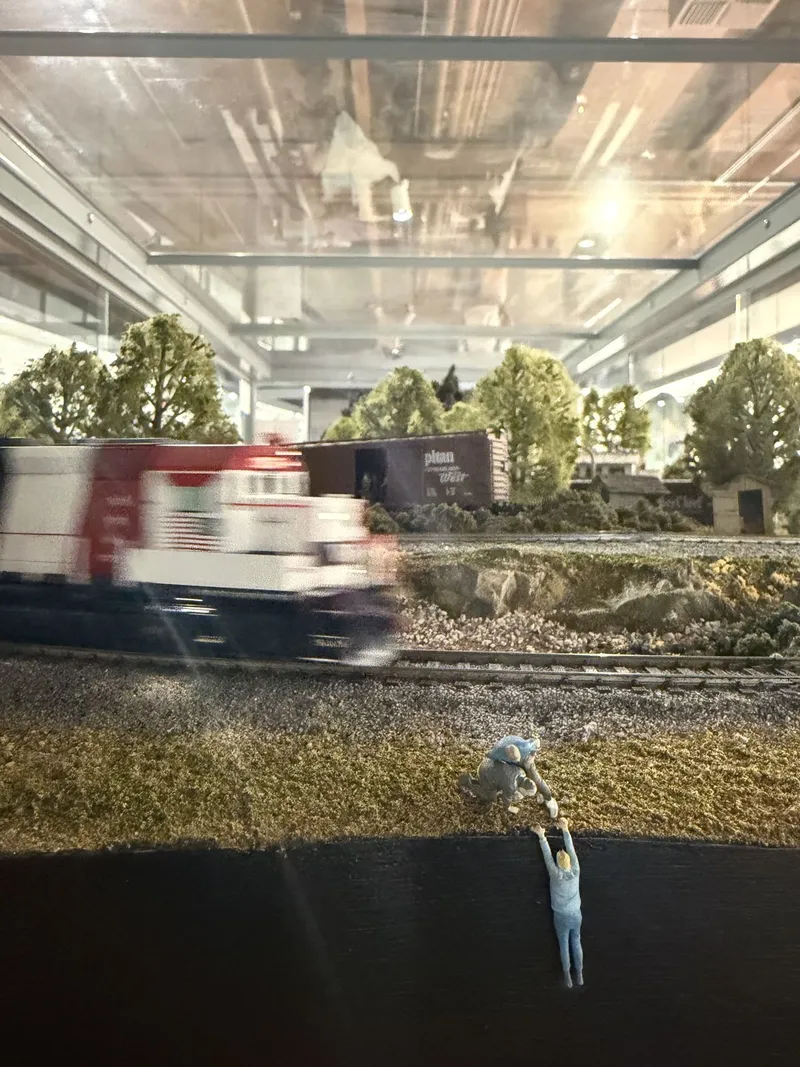
The layout's best joke: a red-and-white diesel blurring past, and in the foreground two figures at the very edge of the benchwork — one dangling off the fascia into the void, his buddy hauling him back up. Model builders having fun with the fourth wall.
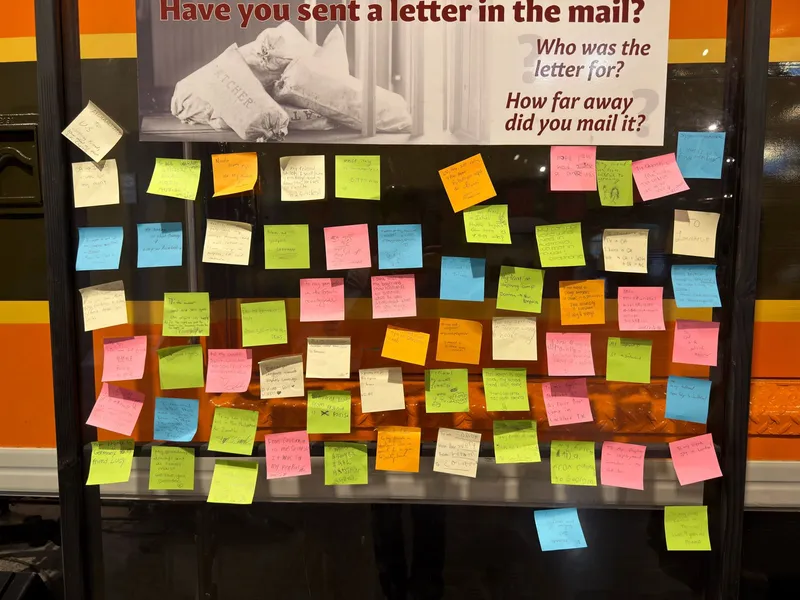
The visitor wall: "Have you sent a letter in the mail? Who was it for? How far away?" — answered in dozens of sticky notes. Afghanistan to the U.S. Fiji. Venice to Sacramento, 5,999 miles. A boyfriend stationed in Bahrain, now a husband. A daughter at Air Force boot camp. A grandma who always sent "snail mail."
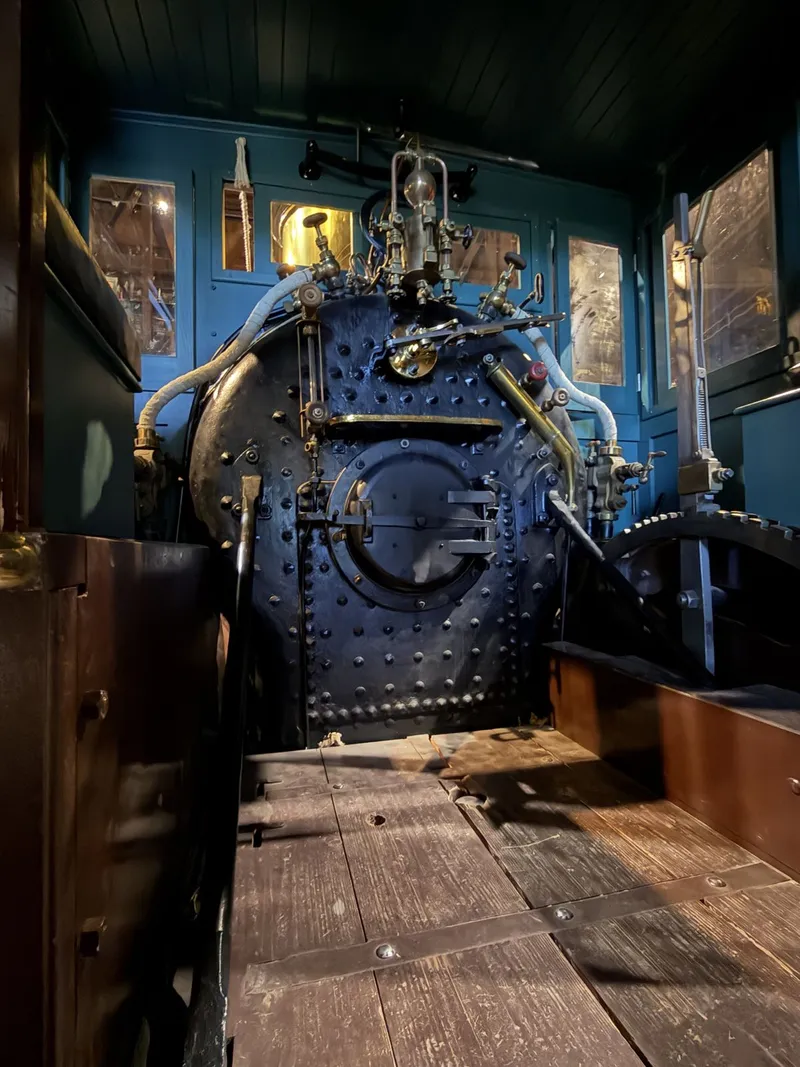
Inside a wood-burner's cab, painted teal: the black riveted backhead like a studded door, the furnace door at its center, white-lagged steam pipes snaking to brass fittings, and daylight through the little arched windows.
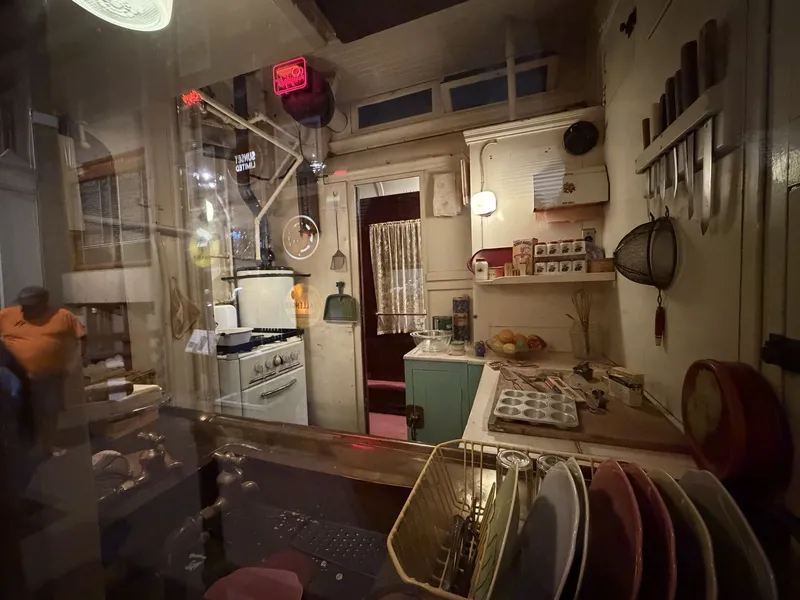
A dining-car galley preserved mid-shift: white enamel stove, muffin tin on the counter, knives on the wall rack, pastel plates in the drying rack, and the Sunset Limited's window lettering reading backwards through the glass, neon glowing beyond.
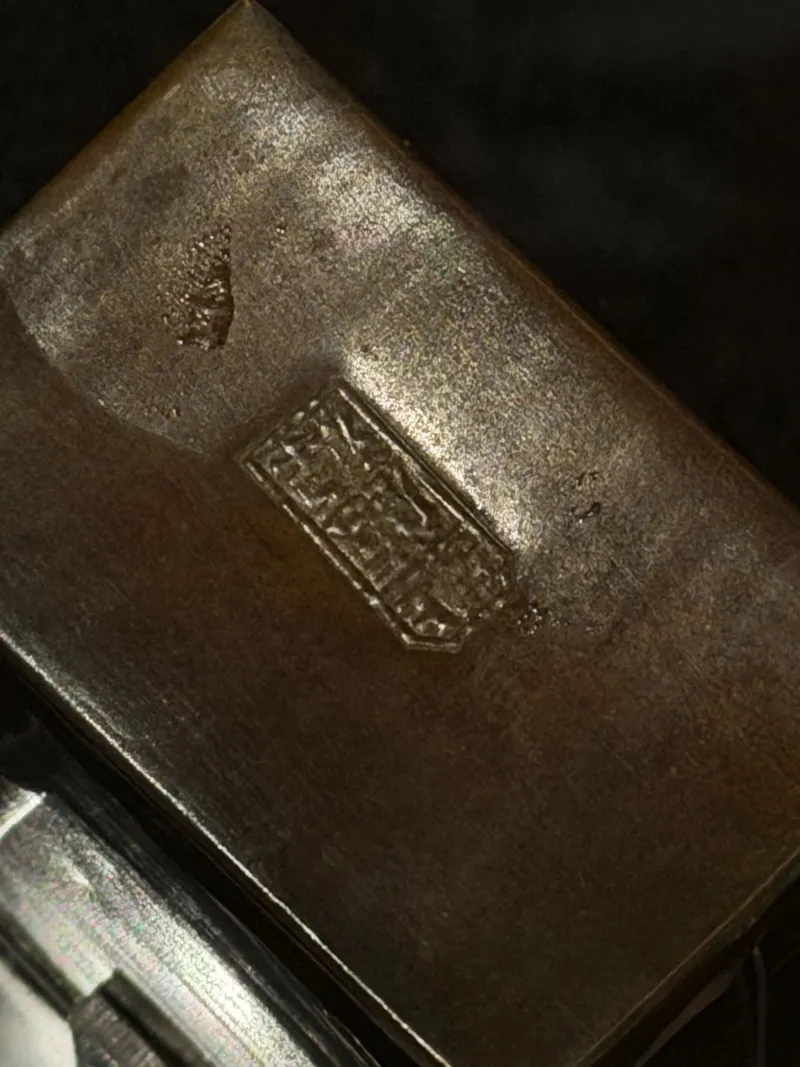
A macro of a brass opium box — the kind archaeologists find by the hundreds at Central Pacific work camps, among the most common artifacts of the Chinese railroad workers' daily lives. The rectangular cartouche is a Chinese maker's or brand stamp, characters running in vertical columns. We worked the image hard — rotation, relief filtering, glare removal — but between a century of wear and the case lighting's glare, the individual characters can't be honestly read from this photo; a reading would be a guess. Stamps like this typically carry the maker's shop or brand name — the licensed Hong Kong brands Fook Lung and Lai Yuen marked their containers exactly this way. A raking-light photo on a return visit would likely crack it.
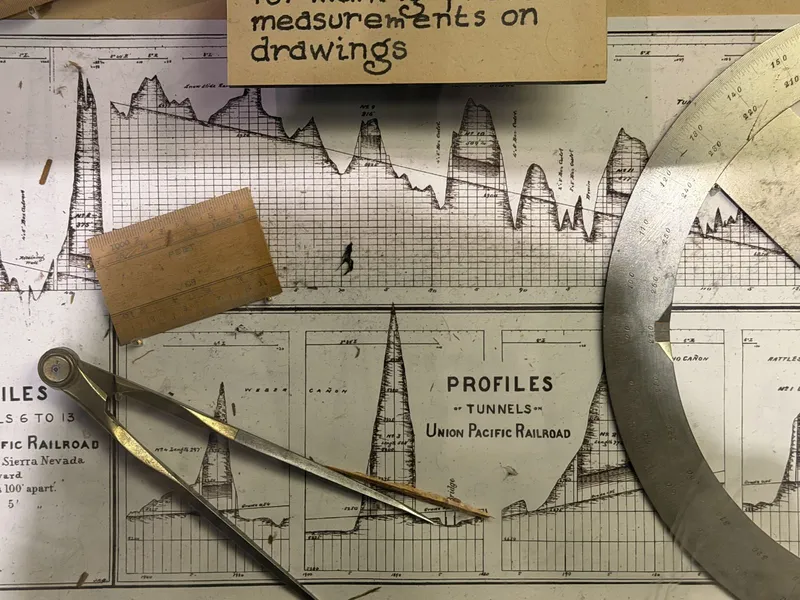
Union Pacific's tunnel profiles under glass: engraved cross-sections of Weber Cañon and its neighbors, a steel protractor arc across the sheet, brass dividers resting where an engineer would have left them.
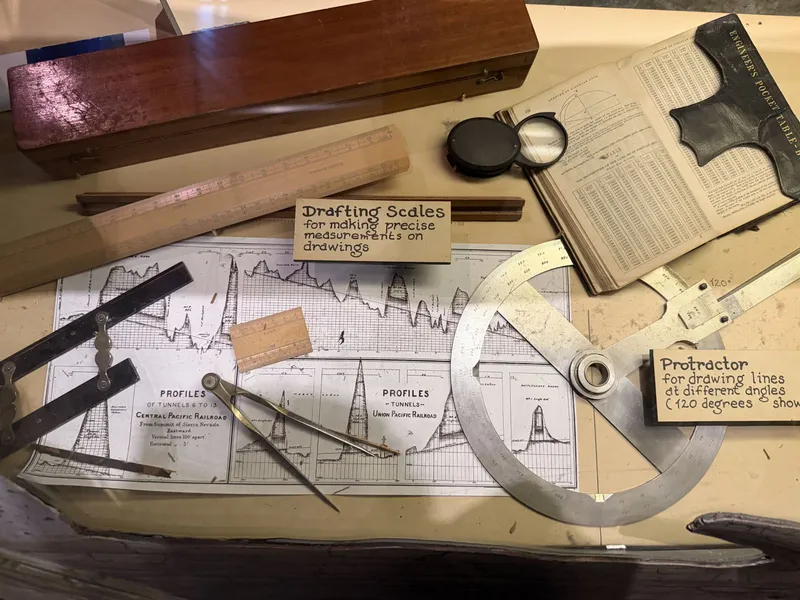
The full surveying case: wooden instrument box, drafting scales, a magnifying loupe, the leather-bound Engineer's Pocket Table-Book propped open, and the big protractor with its hand-lettered card — "for drawing lines at different angles (120 degrees shown)."
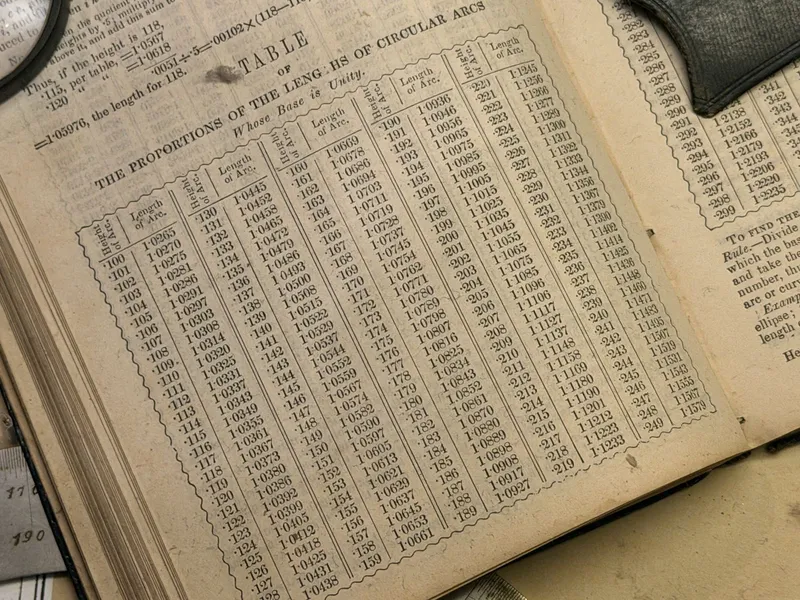
The pocket book up close, open to "The Proportions of the Lengths of Circular Arcs Whose Base Is Unity" — columns of precomputed decimals so a field engineer never had to derive an arc trackside. Cached computation, 1860s edition.
9 · The Westinghouse plate, read completely
A brass patent plate on a Westinghouse 9½-inch air compressor, serial 205746. We transcribed every legible number — 96 of them — and looked each one up individually. Together they map the company's whole world: the compressor's own guts, a dozen brake variations, feed valves, lubricators, dirt collectors, gaskets, and one stray refrigerator car. The full table of all 96, with links to every patent, is the appendix at the bottom of this note — the three we brought to life are bolded.
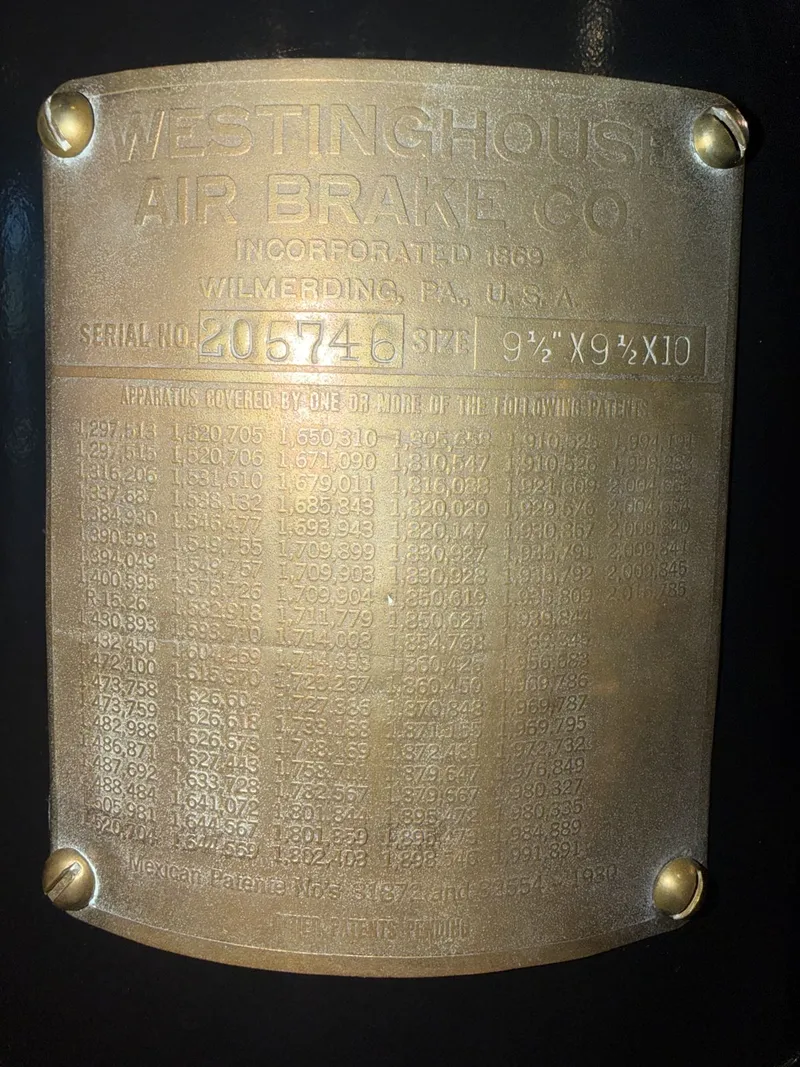
The plate itself: curved brass held by four slotted screws, "Westinghouse Air Brake Co., Incorporated 1869, Wilmerding, PA," serial and cylinder sizes stamped in their boxes, and below, six tight columns of patent numbers — sixteen years of inventions cast into one rectangle.
10 · The patent gallery — three inventions, animated
Three patents off that plate, each rebuilt as an interactive 3D exhibit. Drag to rotate, pinch to zoom; each one has a section view and a brass gauge.
The pipe clamp — US 1,520,705
Clyde C. Farmer, granted December 30, 1924. Pipes on a shaking locomotive snap at their threads, so Farmer clamped them a few inches away from the joint: a split tapered ring, wedged tight by one nut, takes the vibration while the threads just seal. The animation opens exploded, screws itself together, and then runs a vibration test you can watch fail with the clamp removed. The same idea lives under your kitchen sink today.
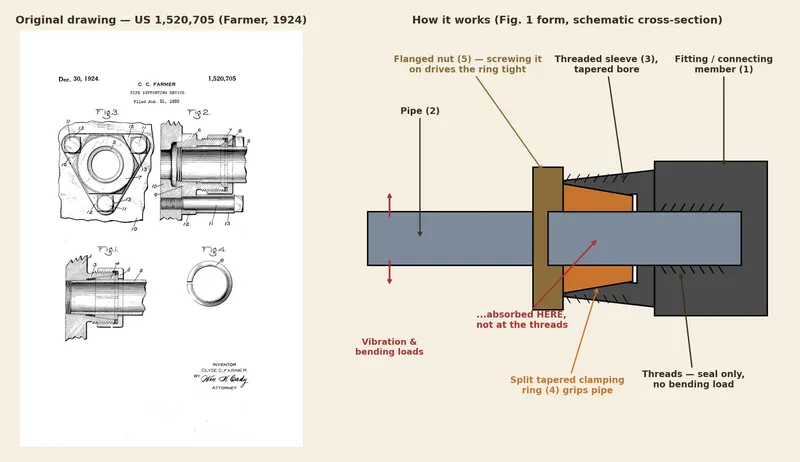
Farmer's original 1924 patent sheet beside our color schematic of how the wedge ring works — vibration absorbed at the clamp, never at the threads.
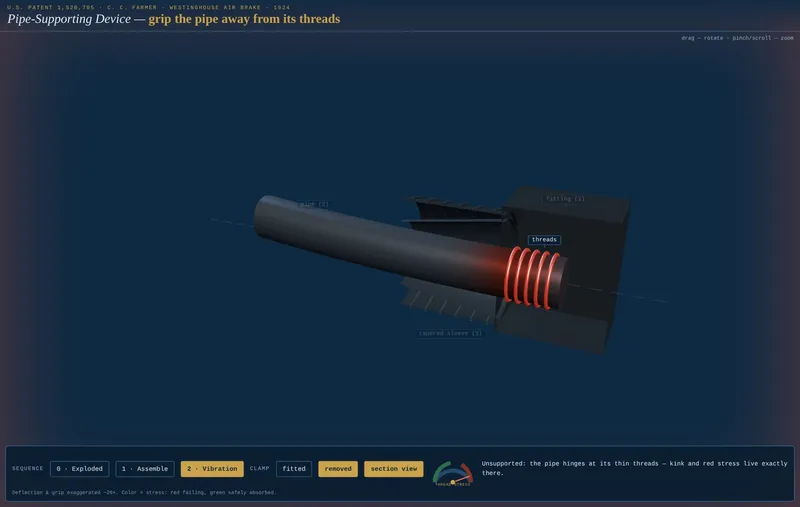
A frame from the animation: the vibration test with the clamp removed — the pipe hinging at its glowing red threads, the stress gauge buried in the red. This is the failure Farmer's ring exists to prevent.
The clamp, live. Drag to rotate; pull the ring and watch the stress gauge go red.
The dirt collector — US 1,520,706
Farmer again, granted the very same day, one serial number later. A little cyclone spliced into the brake pipe: air spins down a funnel, heavy grit slings to the wall and drops into a dust chamber, clean air escapes up the center. It existed because one grain of scale in a brake valve could keep a car from braking. The animation runs live particles, grows a dust pile, and has a blow-down button that dumps it, just like a carman at the terminal.
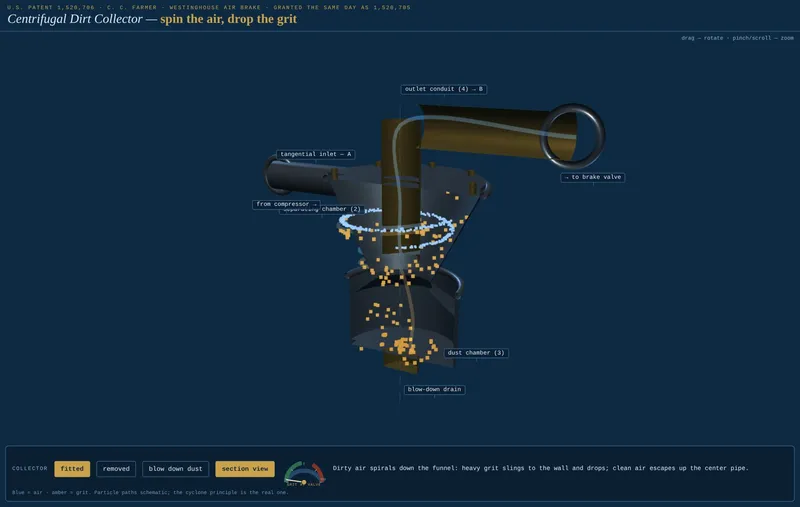
A frame from the animation: the cyclone at work — blue air spiraling the funnel wall, amber grit raining into the dust chamber below, the glowing streamline ribbons tracing both paths, and the grit-at-valve gauge resting easy in the green.
The cyclone, live. Drag to rotate; the blow-down button dumps the dust chamber.
The reversing valve — US 1,879,647
Benjamin H. Thompson, 1932 — the heartbeat inside the very compressor the plate came from. Steam drives a piston up and down; at each stroke end a reversing rod trips a pilot valve, and steam pressure snaps the valves over so the piston reverses. Thompson's snap action meant the pump could never stall half-thrown. The animation runs the whole cross-section, glowing steam and all, and says FWOOSH and CHUNK at the appropriate moments, because that is genuinely the sound.
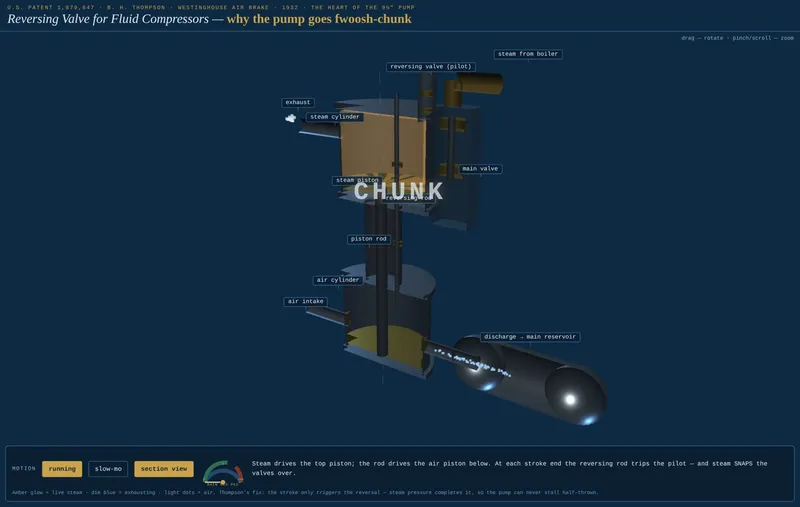
A frame from the animation, caught at the CHUNK: the piston at the bottom of its stroke, live steam glowing amber above it, an exhaust puff escaping, and compressed air streaming down the discharge pipe into the main reservoir.
The valve, live. Drag to rotate; the stroke runs on its own.
Why any of this mattered
The plate is a picture of how reliable systems get built: not one genius and one artifact, but ninety-six small unglamorous fixes — vibrating threads, gritty air, stalling valves — each one a lesson metal taught somebody the hard way, accumulated until a fireman could trust the machine with his life. Pulling one thread honestly, all the way down, turned an afternoon at a museum into all of this.
Appendix · Every patent on the plate
All 96 legible numbers from the Westinghouse plate, each looked up individually on Google Patents. Years estimated from number ranges: 1,297,xxx ≈ 1919 through 2,009,xxx ≈ 1935. The three patents animated above are in bold.
| Patent |
Title |
| 1,297,513 |
Load brake apparatus |
| 1,297,515 |
Locomotive-brake |
| 1,316,206 |
Fluid-pressure brake (title garbled in scan) |
| 1,337,687 |
Automatic oiler |
| 1,384,930 |
Brake-pipe vent-valve |
| 1,390,593 |
Load-brake apparatus |
| 1,394,049 |
Empty and load brake |
| 1,400,595 |
Load brake equipment |
| 1,430,893 |
Feed-valve device |
| 1,432,450 |
Fluid-pressure-brake device |
| 1,472,100 |
Load-brake device |
| 1,473,758 |
Feed-valve device |
| 1,473,759 |
Brake-valve device |
| 1,482,988 |
Holder for angle cocks |
| 1,486,871 |
Lubricator |
| 1,487,692 |
Fluid-pressure brake |
| 1,488,484 |
Valve seat |
| 1,505,981 |
Load brake device |
| 1,520,704 |
Piston packing |
| 1,520,705 |
Pipe-supporting device — the clamp, animated above |
| 1,520,706 |
Centrifugal dirt collector — the cyclone, animated above |
| 1,531,610 |
One-piece handle for angle cocks |
| 1,538,132 |
Piston |
| 1,546,477 |
Pressure-retaining-valve device |
| 1,549,755 |
Automatic lubricator |
| 1,549,757 |
Pipe connection |
| 1,575,726 |
Triple-valve device |
| 1,582,918 |
Brake-valve pedestal |
| 1,593,710 |
Valve-lubricating device |
| 1,604,269 |
Packing and process of making |
| 1,615,370 |
Brake-cylinder device |
| 1,626,604 |
Reservoir device |
| 1,626,618 |
Retaining-valve device |
| 1,627,443 |
Charging valve |
| 1,633,728 |
Feed-valve device |
| 1,641,072 |
Piston packing ring |
| 1,644,567 |
Load-brake device |
| 1,650,310 |
Locomotive brake equipment |
| 1,671,090 |
Brake-valve handle |
| 1,679,011 |
Signal device |
| 1,685,843 |
Duplex pressure retainer |
| 1,693,943 |
Fluid-pressure brake |
| 1,709,899 |
Feed-valve device |
| 1,709,903 |
Feed-valve device |
| 1,709,904 |
Feed-valve device |
| 1,711,779 |
Fluid-pressure brake |
| 1,714,003 |
Adjustable lamp fixture |
| 1,714,033 |
(title illegible in Google scan — 1929-era brake patent) |
| 1,727,386 |
Brake cylinder |
| 1,748,169 |
Valve |
| 1,758,711 |
Signal-valve device |
| 1,782,567 |
Gasket |
| 1,801,844 |
Angle-cock holder |
| 1,801,859 |
Fluid-pressure brake |
| 1,802,403 |
Angle cock |
| 1,805,658 |
Triple valve cylinder cap |
| 1,810,547 |
Brake application valve device |
| 1,816,088 |
Reservoir release valve |
| 1,820,020 |
Pipe coupling |
| 1,820,147 |
Signal valve device |
| 1,830,927 |
Pump governor |
| 1,830,928 |
Pump governor |
| 1,850,619 |
Valve and valve rod construction |
| 1,850,621 |
Brake application valve |
| 1,854,738 |
Dirt collector |
| 1,860,425 |
Dirt collector |
| 1,860,450 |
Diaphragm actuated valve |
| 1,870,848 |
Fluid compressor controlling valve |
| 1,872,481 |
Safety car control equipment |
| 1,879,647 |
Reversing valve for fluid compressors — the pump's heartbeat, animated above |
| 1,879,667 |
Brake cylinder |
| 1,895,472 |
Release valve |
| 1,895,473 |
Fluid pressure brake |
| 1,898,546 |
Signal controlling device |
| 1,910,525 |
Mold for cylinder packing |
| 1,910,526 |
Mold for flat packing |
| 1,921,609 |
Compressor governor |
| 1,929,676 |
Refrigerator car |
| 1,935,791 |
Fluid pressure brake |
| 1,935,792 |
Valve lubricating device |
| 1,935,809 |
Empty and load brake |
| 1,939,844 |
Emergency valve mechanism |
| 1,969,786 |
Piston rod collar |
| 1,969,787 |
Journal box dust guard |
| 1,969,795 |
Gasket |
| 1,972,732 |
Brake cylinder lubricator |
| 1,976,849 |
Valve |
| 1,980,327 |
Back-up valve device |
| 1,980,335 |
Gasket construction |
| 1,984,889 |
Piston ring joint |
| 1,991,891 |
Steam driven compressor |
| 1,998,283 |
Angle cock device |
| 2,004,654 |
Fluid pressure brake |
| 2,009,840 |
Fluid pressure brake |
| 2,009,841 |
Fluid pressure brake |
| 2,009,845 |
Drain valve |
Not resolved: reissue R15,267 (a different numbering series) and roughly a dozen numbers too worn on the brass to read confidently. Also on the plate: Mexican patents 31,872 and 33,554 (1930).
Home


